
This is why AI takes off for some and fails for others
Every organization wants to do something with AI: chatbots, copilots, agents, content, analytics, automation. The promise is great, but the reality is challenging. Many AI initiatives deliver less than hoped for. Sometimes, not at all.
That’s not a matter of bad luck. It’s a matter of design.
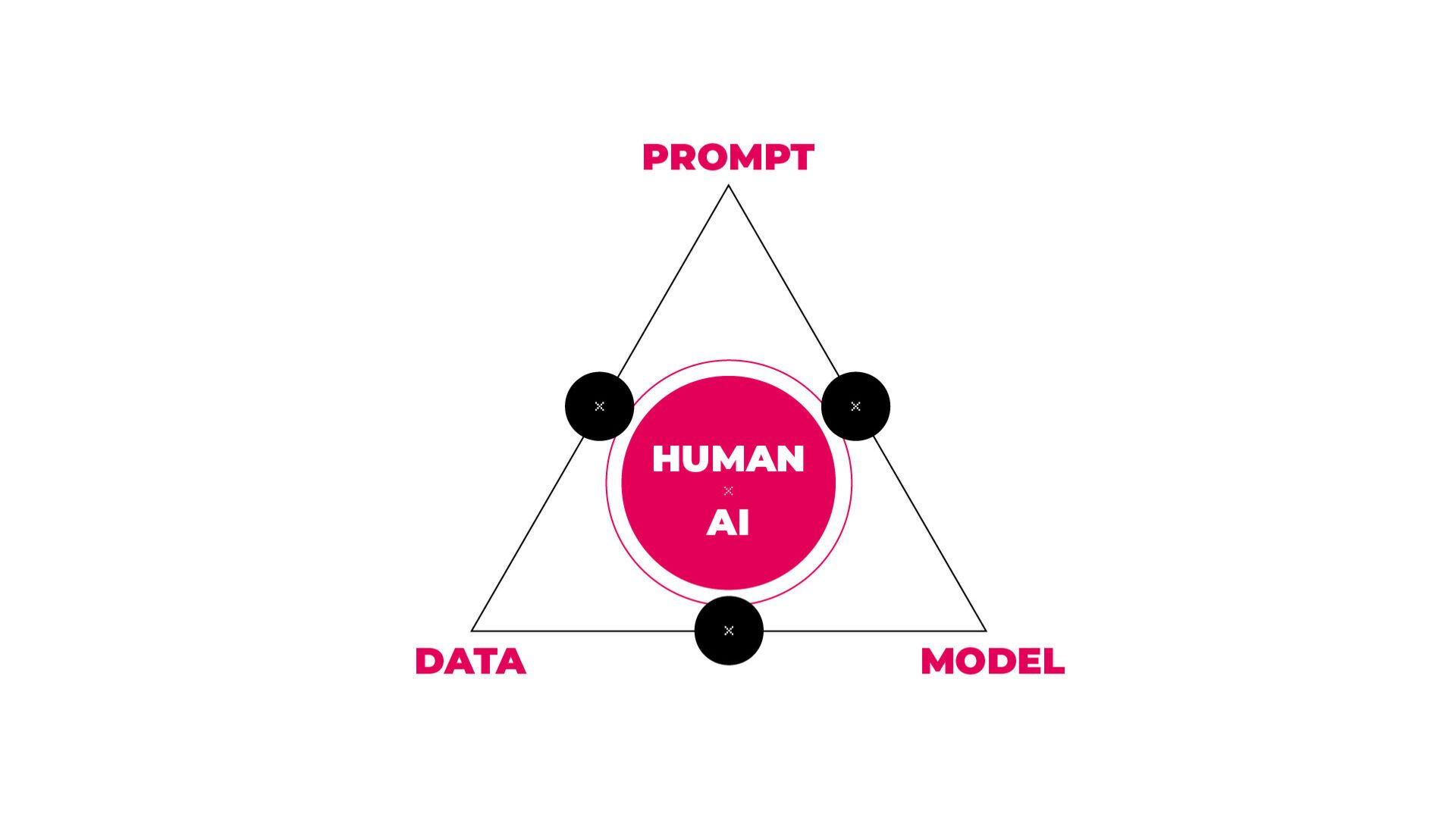
That’s why we don’t view AI as a tool, but as a system. And that system always follows the same formula:
Prompt × Data × Model = AI result
Together, these three form a triangle. They are inextricably linked. If one component is off, the entire structure collapses.
Why AI often disappoints
What we see in practice:
- A powerful model is used, but without clear instructions
- AI is applied to data that is outdated, incomplete, or unvalidated
- The largest model is chosen, even though a smaller model would be a better fit
- Or AI is seen as a replacement for people instead of an enhancement
The result: unreliable output, slow systems, undesirable results, and, above all, frustration among teams and a loss of trust in AI.
The three choices that determine everything
1. The right model, not necessarily the largest
Today, you can choose from closed models like GPT and Gemini, as well as open-source models like Mistral, LLaMA, and Gemma. You can run the latter in your own cloud or even entirely on-premises (within your organization’s infrastructure)
That means:
- More control over data
- Better control over costs
- More opportunities for customization
- And often better performance on specific tasks
Using AI in a mature way doesn’t mean blindly choosing what’s popular, but strategically selecting what fits your use case.
More about the European AI model Mistral
2. Data as strategic capital
AI without data is empty. But AI with the wrong data is dangerous.
The truth is simple:
The quality of your data determines the quality of your decisions.
That’s why we almost always build AI solutions around our own AI database (a vector database). A smart database that understands what’s relevant for each task. It searches not by words, but by meaning.
Human validation is crucial here. Not everything that exists can simply be added to the database. Teams decide together:
- What is accurate
- What’s up to date
- What can be used
- And what is explicitly not
That’s what makes the difference between a nice demo and an AI system that truly helps your organization move forward.
3. The prompt as a control layer
The prompt is not a question, but a policy.
Here’s what you define:
- Behavior
- Tone of voice
- Responsibilities
- Boundaries (guardrails), that is, what AI is not allowed to do
This is especially essential for AI agents that manage processes. Without guardrails, risks arise. With good prompts, scalability is achieved.
Human × AI. Where the real value lies
That’s why our formula always centers on:
Human × AI
Not because AI falls short, but because autonomy without responsibility is never scalable.
Humans:
- Designs the system
- Validates the data
- Monitors the context
- and remains ultimately responsible
AI:
- Processes faster
- Thinks more consistently
- Scales without fatigue
- And makes complex systems manageable
Together, they form a superpower.
AI isn’t a tool. It’s infrastructure.
Organizations that successfully deploy AI do three things differently:
- They deliberately design their AI architecture
- They invest in data and validation
- They position people as directors, not as end users
That’s exactly where we help organizations. Not with standalone tools, but with a cohesive AI system that works in practice, is scalable, and fits your organization.
If you want AI that truly delivers value, it starts here, with the formula.